Today is World Day for Cultural Diversity for Dialogue & Development 🌍
There is overwhelming evidence that diverse teams are good for business (despite what Trump and co. would like us to think!).
Yet companies often struggle to move from dialogue, or performative celebrations, to meaningful development and improvement.
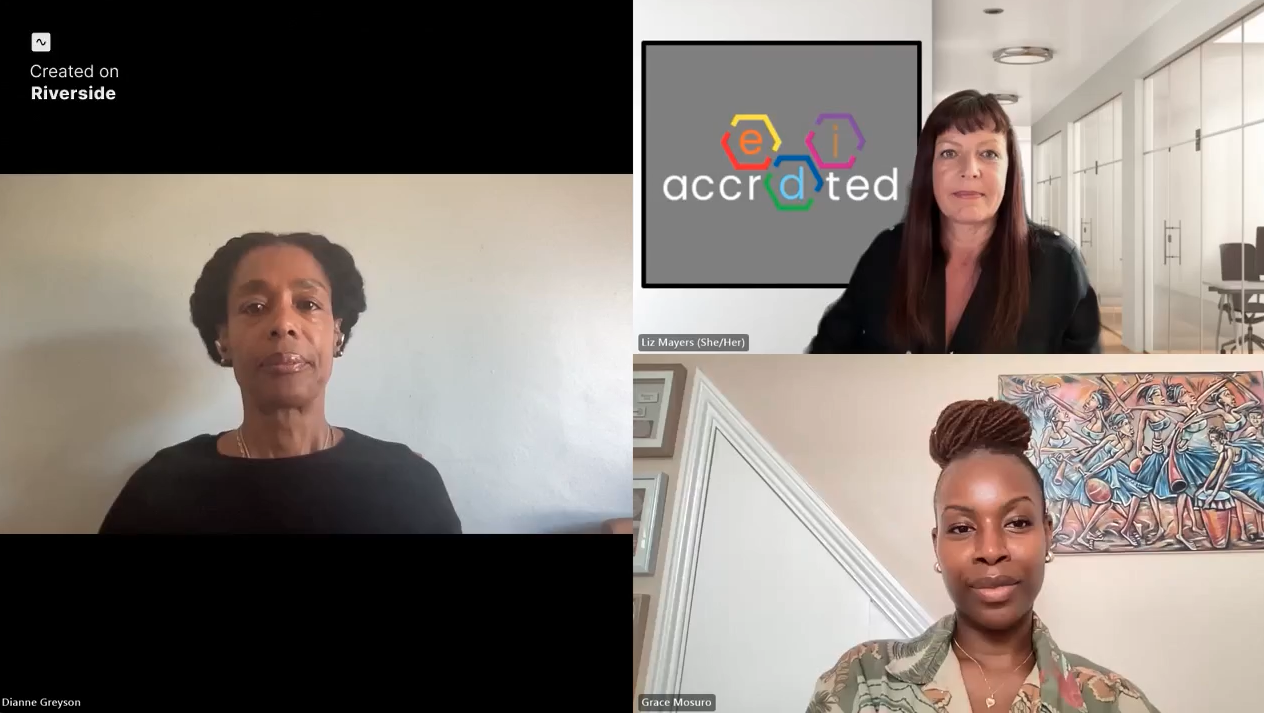
This conversation explores how organisations can really start shifting the needle through intentional action. 🧮 Whether quotas are the answer? 💪 What rolling up your sleeves and doing the work looks like? 😴 And if you exhaust your “only’s”?
During our “In Conversation” series, Co-founder Liz Mayers explores a wide range of equality, diversity & inclusion related topics with our Community of experts, for fun and learning.
The #EthnicityPayGap Campaign was established in 2018 by the awesome Dianne Greyson. Its main aim and purpose is to raise awareness of the issues relating to the Ethnicity Pay Gap and to encourage the government to make Ethnicity Pay Gap reporting mandatory.
The Campaign is also calling on the government to ensure that businesses fully demonstrate that they are taking every action to close the gap. Correspondingly we call for clear guidelines on reporting to help support businesses to understand how to produce pay gap analysis that is meaningful and actionable.
We empower employee voice to enable them to be heard and advocate for representation at all levels of an organisation, making a way for improved outcomes for Black, Asian and other minoritised groups.
The #EthnicityPayGap Campaign is a beacon to those who wish to make a positive change.
Our Community is a directory of amazing specialists that can help with all sorts of EDI related issues and challenges that you might be encountering on your journey. So whilst The #EthnicityPayGap Campaign is a little different to our other Community members, we encourage ethical organisations to support the campaign and take action now to ensure they are not contributing to the Ethnicity Pay Gap.
Access the Community of specialist resources here.
Founded by the amazing Dianne Greyson they provide Strategic Consultancy, developing and executing high-level strategic plans to improve overall performance of long-term business goals and to improve cultural change within an organisation. Equilibrium Mediation Consulting Ltd provides high-level project support on specific change management strategies. Taking a “critical friend” approach that allows you to evaluate your strategy at critical stages of any project.
Our Community is a directory of amazing specialists that can help with all sorts of EDI related issues and challenges that you might be encountering on your journey.
Access the Community of specialist resources here.
Through Mosaic Fusions, Susan Popoola works with leaders and their organisations to navigate the challenges and complexities they encounter on their journeys to create Harmonious and Impactful environments in which everyone’s value is realised for the benefit of all. They support leaders through one to one support, organisation development, workshops, masterclasses and masterminds that create real Equality, Diversity and Inclusion.
Our Community is a directory of amazing specialists that can help with all sorts of EDI related issues and challenges that you might be encountering on your journey.
Access the Community of specialist resources here.
Founded by the inspirational Grace Mosuro Aquaintz Consulting, believe that true inclusion is more than just a policy. It’s a strategic advantage that drives innovation, performance, and employee engagement. They partner with organisations to develop tailored Equality, Diversity, and Inclusion (EDI) strategies, ensuring that every initiative aligns with business goals and fosters genuine cultural transformation.
Their approach is rooted in lived experience, deep expertise, and a commitment to meaningful change. They don’t offer off-the-shelf solutions. Aquaintz Consulting start with strategy, working closely with leadership teams to build frameworks that embed intersectionality, cultural awareness, racial equity, and support for invisible disabilities into the fabric of the organisation.
Our Community is a directory of amazing specialists that can help with all sorts of EDI related issues and challenges that you might be encountering on your journey.
In Race Equality Week it seems particularly appropriate to talk about Ethnic underrepresentation
Understanding the benefits having a diverse workforce brings to an organisation, shows it is an issue that shouldn’t be ignored by companies wanting to attract the best talent, to innovate and be market-leaders. Yet it is a complex and challenging issue, one that many organisations still struggle to address effectively.
We are often asked if introducing quotas is the best way to address representation. The simple answer for us, is “no”. No-one wants to be hired because of the colour of their skin (or any other characteristic). People want to be hired to do a job well, because they are the best candidate for the job. We acknowledge hiring is just part of the solution, talent retention and development are also essential to address underrepresentation, long-term, but will save those topics for another day!
Many organisations believe they hire on meritocracy, but actually need to closely examine their policies and processes to understand the barriers to entry that often exist (unintentionally, or otherwise), which have created inequality in the status quo – and therefore underrepresentation.
Whilst we aren’t a fan of quotas, the first step to addressing underrepresentation is to diagnose who is missing from your workforce. Analysing your existing workforce, by level and job role is an essential starting point.
Considering factors such as location and industry are also important in understanding your talent make-up.
If an organisation is based in rural Cornwall the demographic of available, local talent will be very different than if you are based in central London and may require additional effort.
Historically many industries were dominated by a particular ethnic group or gender. Knowing your industry, the challenges or opportunities that brings, is also essential to successfully address representation.
Understanding how your workforce compares to the population helps you identify who is missing. You can then begin to identify why they are missing. This is rarely as straightforward as bias (unconscious or intentional) from hiring managers during the interview process.
Insisting a candidate has 10 years of industry experience, when historically the industry has been dominated by White talent, immediately eliminates all candidates of Ethnic heritage who are, otherwise, brilliantly qualified for the role. Likewise, requiring candidates to have a degree, doesn’t necessarily guarantee their suitability or aptitude for a role.
Often job descriptions, policies and hiring processes are outdated and need to be completely reimaged to attract and measure talent effectively for today’s workforce. Doing what you’ve always done, simply perpetuates the inequalities and barriers that have been created historically. Review what you are asking for in a job description. Is it relevant to the role? How could it eliminate some groups of people? Revisit your policies and processes to ensure they are fit for purpose. AI based recruitment and talent platforms are also prone to learning bias quickly, so ensure human and AI learning is unbiased and genuinely removing barriers for everyone.
Many organisations (if they monitor EDI data during their hiring process) often conclude the “diverse talent” they hoped to attract, does not exist if “they” don’t apply for a role.
Lack of applications is not usually an accurate reflection of the talent that exists – it simply reflects the talent that is attracted to your organisation.
Lack of attraction can occur because unreasonable hiring criteria eliminates the talent you want, as mentioned above. But is also hugely impacted by what a candidate sees when they look at your organisation. Does it appeal to them? Do they believe they would be welcome and enjoy working for the company? Seeing someone like you represented is powerful if you are from an ethnic or marginalised background. It sends a clear message, you are welcome, you belong and you can flourish here!
The challenge to attract diverse talent can be made harder when the route into an industry, as a whole, is also historically un-diverse (Construction, STEM, Financial Services etc.) and requires intervention much earlier.
So, what do you do if your organisation or industry is not diverse? The answer from an organisational perspective starts with more analysis. Review your messaging and imagery – does your website and social media appeal to your target audience? Does it signal to people they are welcome? Get external feedback from the audiences you want to attract. If changes are required, make sure they are authentic, not tokenistic.
If you are in an industry where ethnic talent is underrepresented, undertaking proactive initiatives that reach that audience and raise awareness of the routes into the industry is essential. Reaching and engaging young people in education and early stage career events creates pathways for fresh new talent, helping to level the playing field.
Publicly showing your support and investment in these initiatives and actively inviting young talent to your business increases your future talent pipeline and is a powerful tool for attracting all talent that exists now. By being a trailblazer in your industry, you automatically become the employer of choice, attracting both active and passive talent.
The Land Collective is one such initiative working to address the barriers that prevent young people from underrepresented backgrounds from accessing careers in the real estate and built environment sectors. These industries have historically relied on established networks and traditional recruitment pathways that often exclude those without prior exposure or industry connections. As a result, many talented individuals are unaware of the opportunities available or struggle to navigate hiring processes that don’t account for different starting points.
To tackle these challenges, The Land Collective focuses on both awareness and preparedness, ensuring that young people not only see real estate as a viable career option but also have the skills and confidence to succeed. Their programmes in partnership with employers provide structured routes into the sector, equipping early talent with industry knowledge, technical training, and professional development opportunities. By embedding employer engagement into these programmes, they help businesses build relationships with diverse candidates long before they enter the formal recruitment process, strengthening their early talent pipelines in a meaningful way.
A proactive approach makes a real difference, not just in attracting applications from underrepresented groups, but in ensuring long-term career progression. Many of the young people they work with go on to secure roles in the industry, and continued support beyond the initial hiring stage helps them to thrive. For employers, this means rethinking how they connect with talent, moving beyond passive recruitment strategies to actively investing in the next generation.
Employers who take a long-term approach to inclusion, supporting talent from the early stages of their career through to leadership, will be the ones driving real change across the sector.
As mentioned, attracting and hiring diverse talent is only part of the equation to improve representation. Like the proverbial leaky bucket, if you are then losing your diverse talent, it will be a never ending challenge to fill the bucket. This is where retention and development are crucial.
To tackle underrepresentation at Leadership level in organisations of every size, retention and barriers to progression (glass and concrete ceilings) must be tackled. Cultures and environments must be inclusive for everyone – allowing people to perform and thrive as their authentic selves.
Founded by the brilliant Lydia Charilaou, Labyrinth Consultants specialise in creating environments where every voice is heard and valued. Their mission aligns perfectly with ours, to transform toxic, challenging workplaces into inclusive, high-performing spaces.
Our Community is a directory of brilliant specialists that can help with all sorts of EDI related issues and challenges that you might be encountering on your journey.
 EDI News