During our “In Conversation” series, Co-founder Liz Mayers explores a wide range of equality, diversity & inclusion related topics with our Community of experts, for fun and learning.
Stress Awareness Month is an annual event observed every April since 1992, dedicated to increasing public awareness about the causes and cures of stress.
If you don’t already have a mental health or wellbeing policy in place, or provide access to support via your workplace, simple steps like:
Setting realistic and achievable targets or deadlines
Making sure people are not regularly having to work additional hours to get through the workload
Creating an open and safe environment where people are not afraid to ask for help and support
can help reduce stress and improve mental health. Which, as well as being kinder to your people, also reduces sickness and absences, boosting productivity!
Today is Transgender Day of Visibility. The day celebrates the joy and resilience of trans and non-binary people, while also combating disinformation, discrimination, and hate.
The day was created in 2010 by trans advocate Rachel Crandall, who wanted a day to celebrate the lives of transgender people while acknowledging the challenges they face.
Today, 15 years later, Transgender Day of Visibility is more needed that ever. With governments in the UK and USA targeting trans people, attempting to remove their rights, making their paths to gender affirming healthcare more difficult than ever and transphobic hate crimes increasing, there has never been a scarier time to be a trans person.
The USA has been grabbing headlines since Trump’s inauguration. With his immediate and extreme Executive Orders aligning with Project 2025 removing Trans rights, before moving on to women and everyone else. People have been likening the dystopian reality unfolding in the US to the book and television series The Handmaid’s Tale. If you want to know more about what is happening in America, Erin Reed is a great LGBTQ+ journalist who gives regular and insightful updates about anti-Trans and anti-LGBTQ+ legislation there.
Whilst, for some, it might feel like a more subtle attack in the UK, the Labour Party has been a huge disappointment to the LGBTQ+ communities since coming to power. With ongoing debates about gender recognition, gender affirming health care, single-sex services, and the impact of the Cass Review on youth gender services, and the government taking steps to clarify legal gender definitions – Trans rights are definitely under attack. The Labour government backtracked in February on promised reforms to make it easier for people to legally change gender.
Wes Streeting, Health Secretary claims to be “led by the evidence” but consistently relies on so called “independent evidence” which, at best leaves Trans voices out and at worst, is deliberately anti-trans. The Sullivan Review (commissioned by the Conservatives but being accepted by Labour) to review how data and statistics record gender identity and “biological sex” is yet another example. The review was led by sociology professor Alice Sullivan. However, Sullivan has ties to anti-trans groups such as Sex Matters. Her association with gender-critical groups should have been seen to compromise her position as an independent reviewer and was a “clear sign of bias” but is something the Health Secretary appears willing to overlook.
Aside from the government’s failing to understand, listen to or represent Trans and Non-binary voices, the media constantly echoes and amplifies anti-trans sentiments, spreading misinformation and stirring up hatred.
What is clear to us through our work, is those with strong anti-trans opinions, have rarely met or know any trans people. Their views have been entirely shaped by scare-mongering headlines.
That is why on this day of Trans Visibility we want others to actually see and hear about Trans people from Trans people. Get to know the human beings who are debated and vilified by a government and media who doesn’t know them.
Our Trans Inclusion Charity Partners Global Butterflies provide Trans and Non-binary Inclusion training, workshops and consultancy to help organisations become more inclusive. Their Global Butterflies Fund was established to support organisations working to advance human rights and protections for trans and non-binary communities in the UK and worldwide raising £33,000 in 2024.
Their founders Rachel Reese and Emma Cusdin said “Transgender Day of Visibility is a day where we celebrate the positivity, strength and resilience of transgender people worldwide. It’s a day where we come collectively together, in the face of growing discrimination towards our community, and stand tall, proud and unbowed. We need all our allies, on every day but especially this day to be loud and active.”
So, in these worrying time for Trans & Non-binary people what can you do to show your support and be a better ally?
In the workplace:
Ensure you have a zero-tolerance approach to transphobia and misgendering
Have positive policies affirming your commitment to equality and respect in the workplace
Ensure Leadership teams and hiring managers have been trained on Inclusive Leadership and hiring practices
Train employees on inclusion topics, including Trans & Non-binary inclusion regularly
Encourage participation in Employee Resource or Special Interest Groups for shared support and learning
Create a safe and inclusive culture where all your people have a sense of belonging and can show up as their authentic selves
Personally:
Learn – educate yourself. Seek out podcasts, books and blogs (start with the ones listed above) that will increase your understanding and help you see the human stories behind the headlines
Always make the effort to use people’s preferred pronouns – if you accidentally mess up, apologise and do better in future
If you hear someone being deliberately or repeatedly misgendered, speak up and correct the mistake
Call out transphobia wherever and whenever you see it
Be an ally to anyone who you see experiencing transphobia
If you care about equality, diversity and inclusion in your workplace, check, do you have a Trans & Non-binary inclusion policy or plan? Do you have Trans or Non-binary staff or customers who you think you could support better?
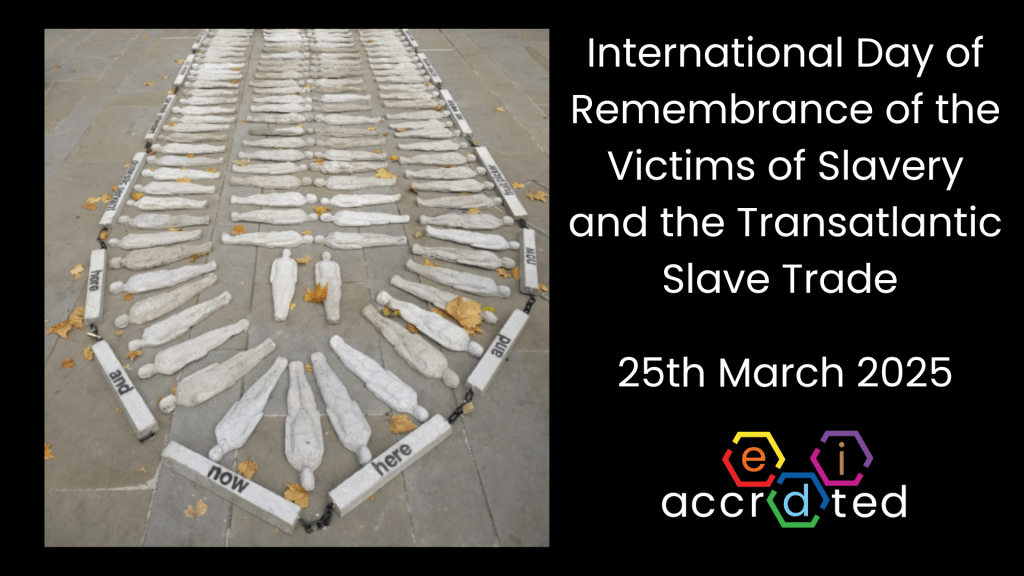
An International Day of Remembrance is not enough. Most “Days of Remembrance” are not enough to truly honour the victims of whatever atrocity took place, be it a murder, a massacre or a war.
For the estimated 15 million victims of the Transatlantic Slave Trade, which lasted almost 400 years, it is definitely not enough.
Some would argue that the Transatlantic Slave Trade was abolished so long ago the victims are no longer alive, so is it still relevant? While it’s difficult to definitively pinpoint the single “last” enslaved person’s death, Hannah Durkin, at Newcastle University, identified an enslaved woman, captured in Africa in the 19th Century and brought to United States called Matilda McCrear who is thought to be one of the last. Matilda died in Selma, Alabama, in January 1940, at the age 83. Daniel Smith, who was believed to be one of the last children of an enslaved person, died on October 19, 2022, at the age of 90. Which brings the distant past frighteningly close.
Even for distant descendants of enslaved people, the implications are still felt today. Our founders’ families are of West Indian descent. The Mayers name undoubtedly linked to John Pollard Mayers, Joseph Mayers or Joshua Mayers Gittens. All registered owners of enslaved people in Barbados. The Pearson name also has ties to the Slave Trade in Jamaica. Surnames giving clues to their ancestral families histories. Family trees that come to an abrupt halt, with DNA tests now the only way to trace their true origins.
There have been many campaigns for reparatory justice in the form of economic and social compensation the over the years. Reparations is a complex and contentious subject. How do you begin to value the lives taken, the trauma and suffering caused and the lasting economic damage? And who is going to foot the bill?
Many countries have issued “statements of regret” instead of apologies, resistant to the idea of accepting responsibility and weakening their stance on owing reparations. In September 2015 the British Prime Minister, David Cameron, on an official visit, told the Jamaican Parliament that “the Black people should cease looking back to slavery days and focus on the future.” As a descendant beneficiary of a fortune made by his enslaver ancestors in Jamaica, the Prime Minister’s statement was particularly insulting and misplaced.
Worse than the refusal to consider reparations or even provide an apology, is that in 1835 after slavery was abolished, British slave owners were compensated for their “loss of property”. A staggering figure (for 1835) of £20million was paid to slave owners. A debt which according to the Tax Justice Network, British taxpayers finally finished paying off in 2015, the same year as Cameron’s visit to Jamaica.
Let that sink in for a moment… every taxpayer in the UK up until 2015 was paying the bill for compensating slave owners. Meaning every Black working person in Britain between 1835 and 2015 was compensating the families that had potentially enslaved their ancestors.
When the history of the Transatlantic Slave Trade is taught in schools, we hear the names of compassionate abolitionists who campaigned for (and eventually achieved) the abolition of slavery on the grounds of social justice and humanity. However, we are not taught about the revolutions of enslaved people taking place in Haiti led by Toussaint Louverture, or Jamaica by key figures such as Samuel Sharpe and Nanny of the Maroons, or across the colonies. Without these uprisings, and a decline in the economic importance of slavery due to the industrial revolution, it is questionable whether the abolition movements would’ve achieved success.
The famous billboard slogan “We did not come to Britain. Britain came to us.” makes an important distinction for those people who are anti-immigration, anti-refugee, (or just plain racist). It is because of Britain’s history, its colonial past and participation in the Transatlantic Slave Trade that we have a wonderful multicultural society today. For a fascinating whistle-stop history lesson on Black History, Colonialism and the Transatlantic Slave Trade, that you didn’t get at school, we highly recommend checking out Akala’s address at the Oxford Union.
We believe understanding Britain’s true history, not the “white-washed” version taught in schools throughout the Commonwealth, plays a really important role in improving ethnic pride, integration and acceptance. For us, more than a day of remembrance, that acceptance would really honour the victims of the Transatlantic Slave Trade.
Do you think about gender balance, gender inclusion or gender equity in your workplace – and is there a difference?
And find out what midwives, firefighters and golf courses have to do with it!
During our “In Conversation” series, Co-founder Liz Mayers explores a wide range of equality, diversity & inclusion related topics with our Community of experts, for fun and learning.
This year marks the 60th anniversary of the International Convention on the Elimination of All Forms of Racial Discrimination.
Yet today, 60 years later, António Guterres Secretary-General of The United Nations acknowledged in his personal message “The poison of racism continues to infect our world”. Going on to say “I call for universal ratification of the Convention, and for States to implement it in full. And I urge business leadership, civil society, and everyday people to take a stand against racism in all its forms…”
In the last 60 years, some progress has been made. The Race Relations Act came into force in the UK in 1965, banning racial discrimination in public place places, and made the incitement of racial hatred illegal. In 1968, the Act was updated to address the issues of discrimination in the workplace and accessing accommodation. In 1976, the Act was extended again to define and include direct and indirect discrimination. The Commission for Racial Equality was formed in 1976 too (later replaced by the Equality and Human Rights Commission in 2007). In 2000 we saw the Race Relations Amendment Act requiring public authorities to actively promote racial equality. Then 15 years ago in 2010, the Equality Act came into force, updating and replacing the previous legislation.
In Global politics we also saw encouraging signs of change, with Apartheid being abolished in 1992, Paul Boateng becoming the UKs first Black Cabinet Minister in 2002, America electing its first Black President in 2009 and what was lauded as “Britian’s most ethnically diverse Cabinet ever” in 2019 with six Cabinet Ministers being of ethnic heritage. Including Rishi Sunak who went on to become Prime Minister in 2022.
Yet for every step forward we appear to take, we seem to take several backwards too.
In 1970, the infamous Mangrove Nine trial. In 1981, the Brixton Riots. In 1993, the murder of Stephen Lawrence, which prompted the Macpherson Report to be published in 1999, concluding that the Metropolitan Police was institutionally racist. The racially motivated murders of Mi Gao Huang Chen and Anthony Walker in 2005, and Mushin Ahmed in 2015. The Institute of Race Relations monitors deaths with a known or suspected racial element in the UK. Their research indicates that between 1993 and 2013 that there were at least 105 such deaths in the UK. The Windrush Scandal in 2018, exposed the wrongful detention, deportation and denial of legal rights to Commonwealth citizens who had settled in the UK and continues unresolved today. In 2024 Race Riots broke out across the UK.
In 2023, the Guardian reported that Black people are seven time more likely to die after police restraint. The Institute of Race Relations report included the IOPCs 2019/2020 statistics revealing that 23% of deaths in, or following, police custody are people of ethnic heritage, disproportionately much higher than the ethnic population.
Between 2013 and 2023, according to official data, police recorded hate crimes, in England and Wales rose from 41,294 to a staggering 145,214. In 2013/14 the number of successful convictions for racist or religious hate crimes was 10,532, just under 25%.
All this depressing reading doesn’t begin to detail workplace racism and inequality. Suffice it to say, the CIPD report two-thirds of Black employees in the UK experienced racism last year! Race Discrimination claims have also risen since 2018 according to legal firm Wright Hassall.
Our Charity Partner, Race Equality First are on the frontline working to eliminate racial discrimination and support the victims of hate crime. Their CEO Aliya Mohammed says “Racism continues to be a persistent and deeply ingrained issue in our society. While we have made legal and policy advancements over the decades, we still see racial discrimination in workplaces, in policing, in the justice system, and on our streets. At Race Equality First, we stand firm in our commitment to fighting racial injustice and supporting those affected by hate crime and discrimination. True change requires not just legislation but a collective effort from all of us to challenge racism wherever we see it.”
Their continuous work with the UN aims to bring about lasting change by contributing to international discussions on racial equality, providing evidence on racial discrimination in the UK, and advocating for stronger protections for marginalised communities.
So, 60 years on, what can we all do better to eliminate racial discrimination now?
In the workplace:
Ensure you have a zero-tolerance approach to racism
Have positive policies affirming your commitment to equality and respect in the workplace
Ensure Leadership teams and hiring managers have been trained on Inclusive Leadership and hiring practices
Train employees on anti-racism and inclusion topics regularly
Encourage participation in Employee Resource Groups for shared support and learning
Create a safe and inclusive culture where all your people have a sense of belonging and can show up as their authentic selves
Personally:
Learn – educate yourself on different ethnic groups, religions and cultures. Seek out podcasts, books and blogs that will increase your understanding of people with backgrounds different to your own
Take steps to understand your own biases and privilege
Understand the difference between “not being racist” and “anti-racist” – to create change we all need to be actively anti-racist.
Call out racism wherever and whenever you see it
Be an ally to those who are experiencing racism
If you care about equality, diversity and inclusion in your workplace, check, do you have an EDI policy or plan? Do you have employees of ethnic heritage and a good approach to inclusion to ensure all your people feel welcome and safe?
Thankfully more and more organisations are realising the benefits of having diverse teams and diverse thinking. But what does that actually mean?
“Diversity” is a frequently used word. People often only think about diversity in terms of visual differences like gender or ethnicity. However, it is also about invisible differences like our sexual orientation, disability, religion and belief, socio-economic background, our care responsibilities or home life (and hundreds of other things). All these elements impact the way we navigate the world and make each of us unique.
The term neurodiversity refers to the different ways a person’s brain processes information. It is an umbrella term used to describe a number of these alternative thinking styles such as Dyslexia, DCD (Dyspraxia), Dyscalculia, Autism and ADHD. The term used to describe people who are not neurodivergent is neurotypical. It is estimated that around 1 in 7 people in the UK have some kind of neuro difference.
We know that teams of people with differing views, experiences and approaches are proven to be the most innovative, productive, best at problem solving… and so ultimately the most profitable.
So having people who are literally wired to process and think differently in your team can bring a range of superpowers that you might be missing.
Historically, a lack of understanding and knowledge has meant neurodivergent people have been hugely disadvantaged by education systems and workplaces designed for neurotypical thinkers.
Neurodivergence is not an indication of low intelligence (in fact, often quite the opposite). However, tasks that seem simple for neurotypical people (like sitting still when unstimulated) can be challenging and were often wrongly interpreted as behavioural issues. This lack of understanding this has resulted in disproportionately high numbers of neurodivergent people being excluded from schooling and struggling to find employment.
Nic Lander, Founder of our Charity Partner, the Kimel Foundation said “Research suggests that 92.1% of people with significant absence from school are neurodivergent, with 83.4% being autistic. Many neurodivergent children are not getting the education and support they need, with one in four autistic children waiting more than three years to receive the support they need at school, so it is unsurprising this impacts young people’s employment opportunities too.”. According to the ADHD Foundation just 22% of autistic adults were in paid employment in 2021.
According to the CIPD, one in five neurodivergent employees has experienced harassment or discrimination at work. Meaning once in employment, the experience is often traumatic or challenging.
The Kimel Foundation’s mission is to “Nurture and incubate the unexplored talent of autistic and neurodivergent people.” They provide training and support for neurodivergent young people to help them into work. And CPD accredited Employer Solutions to help organisations build inclusive workplaces where neurodivergent people feel they belong and flourish.
The previous lack of understanding about neurodiverse conditions has meant some people haven’t ever been formally diagnosed, or receive a diagnosis later in life. Getting a diagnosis often helps people make sense of the issues they have silently struggled with for years and enables them to put in place effective coping strategies.
For example, some neurodivergent people are affected by sensory overwhelm, where neurotypical people are largely unaffected by noise and lighting, they can be more sensitive to these factors and can find them debilitating. Simple steps like using noise-cancelling headphones help to reduce sensory overwhelm and make situations that were really difficult, manageable.
One of our brilliant Community members, Lydia Charilaou founder of Labyrinth Consulting was not diagnosed with AuDHD until well into her successful career in HR. Having led global Talent Development & EDI teams and performed at the highest level, one could argue her diagnosis was irrelevant. However, Lydia sees it differently. She reflects, “Unlike other late – diagnosed neurodivergent people, I’ve met, I never felt ‘different’. My family origins are Greek-Cypriot, and Mediterranean families are typically large, loud, and deeply interconnected. There wasn’t much space to stand out or be seen as ‘different’. Even today, I hear comments like, ‘There’s nothing wrong with you’.”
She adds, “For girls and women especially, masking starts young. Societal norms shape how we behave and show up. I just assumed everyone experienced the world the way I did. It was only later I realised my inner critic is significantly louder than that of neurotypical people.
As a child, that inner critic often left Lydia feeling as though she wasn’t good enough. Comments like, “Stop procrastinating and get on with your work,” fed her self-doubt. So, she masked, spending hours in her room ‘doing homework’ to meet expectations. She reflects, “I was a good student overall, though some subjects, like maths, were painful. I’ve wondered about dyscalculia but have never pursued it. On the flip side, when I’m engaged by a topic that excites me or plays to my strengths, I show up differently. I hyperfocus, leave no stone unturned, and can’t stop sharing everything I’ve discovered.”
In her career, this hyperfocus has drawn attention from managers, but before her diagnosis, she didn’t fully understand why. Now, she’s more aware of how comments, whether well-intentioned or not, have fuelled her Rejection Sensitivity Dysphoria (RSD).
As we mark Neurodiversity Awareness Week, Lydia shares this heartfelt wish: “I hope we continue to challenge stereotypes and misconceptions around neurodivergence.” She also offers this insightful analogy: “Imagine a gas cooker with multiple heat dials representing different neurodivergent characteristics. Each neurodivergent person has their own unique dial combinations. We’re as individual as any neurotypical person, no two of us are the same.”
This Neurodiversity Celebration Week we want to improve awareness and kick-start the conversation in workplaces about the superpowers you’re missing out on! Did you know an autistic person correctly placed and supported within an organisation can be up to 140% more productive than their neurotypical peers?
If you care about equality, diversity and inclusion in your workplace, do you have a neuro-inclusion policy or plan? Do you have neurodivergent staff who haven’t dared to show you their superpowers yet?
Final words of wisdom from Gemma and rallying call from Mo finished the conversation in a positive and hopeful way. Will you be part of the rebellion?
During our “In Conversation” series, Co-founder Liz Mayers will explore a wide range of equality, diversity & inclusion related topics with our Community of experts, for fun and learning.
Valerie Spicer, Pod’s EDI Lead, commented: “For us, this is not just about ticking a box – it’s about embedding EDI into the very heart of our company culture, so everyone feels safe, valued and respected. Our dedicated EDI working group will be working hard to make this happen.”
Interested to know what starting the journey could mean for you? Please get in touch to find out more.
Founded by the inspirational Grace Mosuro Aquaintz Consulting, believe that true inclusion is more than just a policy. It’s a strategic advantage that drives innovation, performance, and employee engagement. They partner with organisations to develop tailored Equality, Diversity, and Inclusion (EDI) strategies, ensuring that every initiative aligns with business goals and fosters genuine cultural transformation.
Their approach is rooted in lived experience, deep expertise, and a commitment to meaningful change. They don’t offer off-the-shelf solutions. Aquaintz Consulting start with strategy, working closely with leadership teams to build frameworks that embed intersectionality, cultural awareness, racial equity, and support for invisible disabilities into the fabric of the organisation.
Our Community is a directory of amazing specialists that can help with all sorts of EDI related issues and challenges that you might be encountering on your journey.




 EDI News