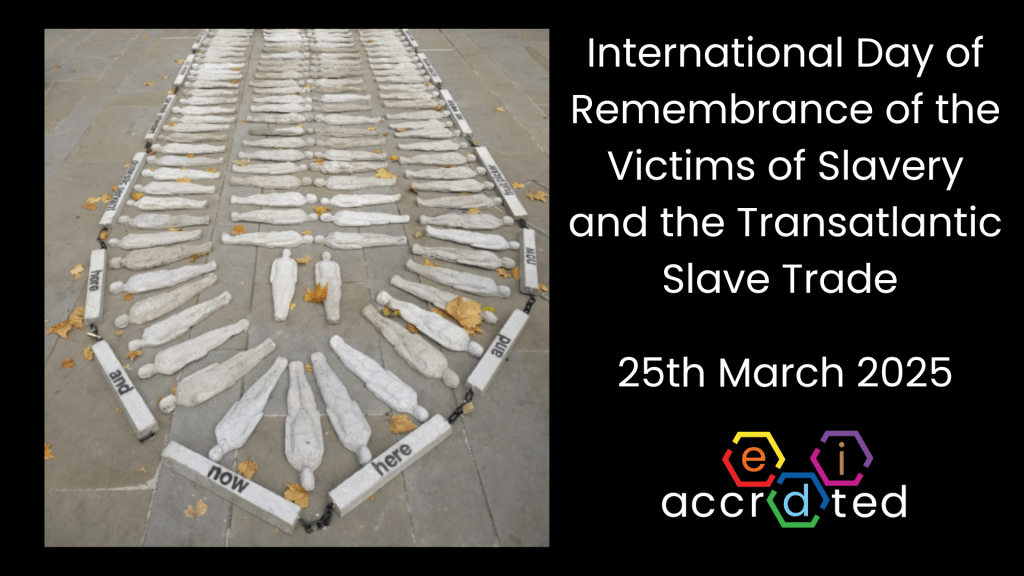
An International Day of Remembrance is not enough. Most “Days of Remembrance” are not enough to truly honour the victims of whatever atrocity took place, be it a murder, a massacre or a war.
For the estimated 15 million victims of the Transatlantic Slave Trade, which lasted almost 400 years, it is definitely not enough.
Some would argue that the Transatlantic Slave Trade was abolished so long ago the victims are no longer alive, so is it still relevant? While it’s difficult to definitively pinpoint the single “last” enslaved person’s death, Hannah Durkin, at Newcastle University, identified an enslaved woman, captured in Africa in the 19th Century and brought to United States called Matilda McCrear who is thought to be one of the last. Matilda died in Selma, Alabama, in January 1940, at the age 83. Daniel Smith, who was believed to be one of the last children of an enslaved person, died on October 19, 2022, at the age of 90. Which brings the distant past frighteningly close.
Even for distant descendants of enslaved people, the implications are still felt today. Our founders’ families are of West Indian descent. The Mayers name undoubtedly linked to John Pollard Mayers, Joseph Mayers or Joshua Mayers Gittens. All registered owners of enslaved people in Barbados. The Pearson name also has ties to the Slave Trade in Jamaica. Surnames giving clues to their ancestral families histories. Family trees that come to an abrupt halt, with DNA tests now the only way to trace their true origins.
There have been many campaigns for reparatory justice in the form of economic and social compensation the over the years. Reparations is a complex and contentious subject. How do you begin to value the lives taken, the trauma and suffering caused and the lasting economic damage? And who is going to foot the bill?
Many countries have issued “statements of regret” instead of apologies, resistant to the idea of accepting responsibility and weakening their stance on owing reparations. In September 2015 the British Prime Minister, David Cameron, on an official visit, told the Jamaican Parliament that “the Black people should cease looking back to slavery days and focus on the future.” As a descendant beneficiary of a fortune made by his enslaver ancestors in Jamaica, the Prime Minister’s statement was particularly insulting and misplaced.
Worse than the refusal to consider reparations or even provide an apology, is that in 1835 after slavery was abolished, British slave owners were compensated for their “loss of property”. A staggering figure (for 1835) of £20million was paid to slave owners. A debt which according to the Tax Justice Network, British taxpayers finally finished paying off in 2015, the same year as Cameron’s visit to Jamaica.
Let that sink in for a moment… every taxpayer in the UK up until 2015 was paying the bill for compensating slave owners. Meaning every Black working person in Britain between 1835 and 2015 was compensating the families that had potentially enslaved their ancestors.
When the history of the Transatlantic Slave Trade is taught in schools, we hear the names of compassionate abolitionists who campaigned for (and eventually achieved) the abolition of slavery on the grounds of social justice and humanity. However, we are not taught about the revolutions of enslaved people taking place in Haiti led by Toussaint Louverture, or Jamaica by key figures such as Samuel Sharpe and Nanny of the Maroons, or across the colonies. Without these uprisings, and a decline in the economic importance of slavery due to the industrial revolution, it is questionable whether the abolition movements would’ve achieved success.
The famous billboard slogan “We did not come to Britain. Britain came to us.” makes an important distinction for those people who are anti-immigration, anti-refugee, (or just plain racist). It is because of Britain’s history, its colonial past and participation in the Transatlantic Slave Trade that we have a wonderful multicultural society today. For a fascinating whistle-stop history lesson on Black History, Colonialism and the Transatlantic Slave Trade, that you didn’t get at school, we highly recommend checking out Akala’s address at the Oxford Union.
We believe understanding Britain’s true history, not the “white-washed” version taught in schools throughout the Commonwealth, plays a really important role in improving ethnic pride, integration and acceptance. For us, more than a day of remembrance, that acceptance would really honour the victims of the Transatlantic Slave Trade.
Creating brilliant environments, where everyone belongs and can flourish as their true selves, doesn’t happen by accident. If you would like to know how becoming accrEDIted© can help you improve EDI for all your people, please get in touch.
 EDI News