Founded by the amazing Dianne Greyson they provide Strategic Consultancy, developing and executing high-level strategic plans to improve overall performance of long-term business goals and to improve cultural change within an organisation. Equilibrium Mediation Consulting Ltd provides high-level project support on specific change management strategies. Taking a “critical friend” approach that allows you to evaluate your strategy at critical stages of any project.
Our Community is a directory of amazing specialists that can help with all sorts of EDI related issues and challenges that you might be encountering on your journey.
Access the Community of specialist resources here.
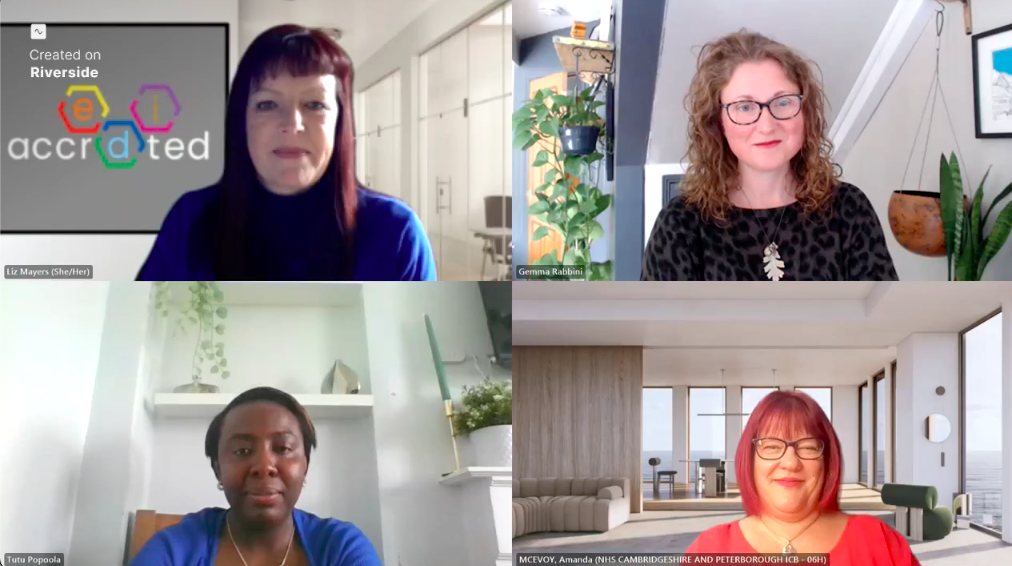
With Women’s History Month just over and April being Stress Awareness Month, what better time to explore ways for women to support their own careers and wellbeing, from the inside out.
If you are a woman, employ women, or have women in your life you care about, tune in to hear these simple but effective ways to support women better.
Watch the full conversation here 👇
During our “In Conversation” series, Co-founder Liz Mayers explores a wide range of equality, diversity & inclusion related topics with our Community of experts, for fun and learning.
Through Mosaic Fusions, Susan Popoola works with leaders and their organisations to navigate the challenges and complexities they encounter on their journeys to create Harmonious and Impactful environments in which everyone’s value is realised for the benefit of all. They support leaders through one to one support, organisation development, workshops, masterclasses and masterminds that create real Equality, Diversity and Inclusion.
Our Community is a directory of amazing specialists that can help with all sorts of EDI related issues and challenges that you might be encountering on your journey.
Access the Community of specialist resources here.
During our “In Conversation” series, Co-founder Liz Mayers explores a wide range of equality, diversity & inclusion related topics with our Community of experts, for fun and learning.
Do you think about gender balance, gender inclusion or gender equity in your workplace – and is there a difference?
And find out what midwives, firefighters and golf courses have to do with it!
During our “In Conversation” series, Co-founder Liz Mayers explores a wide range of equality, diversity & inclusion related topics with our Community of experts, for fun and learning.
Thankfully more and more organisations are realising the benefits of having diverse teams and diverse thinking. But what does that actually mean?
“Diversity” is a frequently used word. People often only think about diversity in terms of visual differences like gender or ethnicity. However, it is also about invisible differences like our sexual orientation, disability, religion and belief, socio-economic background, our care responsibilities or home life (and hundreds of other things). All these elements impact the way we navigate the world and make each of us unique.
The term neurodiversity refers to the different ways a person’s brain processes information. It is an umbrella term used to describe a number of these alternative thinking styles such as Dyslexia, DCD (Dyspraxia), Dyscalculia, Autism and ADHD. The term used to describe people who are not neurodivergent is neurotypical. It is estimated that around 1 in 7 people in the UK have some kind of neuro difference.
We know that teams of people with differing views, experiences and approaches are proven to be the most innovative, productive, best at problem solving… and so ultimately the most profitable.
So having people who are literally wired to process and think differently in your team can bring a range of superpowers that you might be missing.
Historically, a lack of understanding and knowledge has meant neurodivergent people have been hugely disadvantaged by education systems and workplaces designed for neurotypical thinkers.
Neurodivergence is not an indication of low intelligence (in fact, often quite the opposite). However, tasks that seem simple for neurotypical people (like sitting still when unstimulated) can be challenging and were often wrongly interpreted as behavioural issues. This lack of understanding this has resulted in disproportionately high numbers of neurodivergent people being excluded from schooling and struggling to find employment.
Nic Lander, Founder of our Charity Partner, the Kimel Foundation said “Research suggests that 92.1% of people with significant absence from school are neurodivergent, with 83.4% being autistic. Many neurodivergent children are not getting the education and support they need, with one in four autistic children waiting more than three years to receive the support they need at school, so it is unsurprising this impacts young people’s employment opportunities too.”. According to the ADHD Foundation just 22% of autistic adults were in paid employment in 2021.
According to the CIPD, one in five neurodivergent employees has experienced harassment or discrimination at work. Meaning once in employment, the experience is often traumatic or challenging.
The Kimel Foundation’s mission is to “Nurture and incubate the unexplored talent of autistic and neurodivergent people.” They provide training and support for neurodivergent young people to help them into work. And CPD accredited Employer Solutions to help organisations build inclusive workplaces where neurodivergent people feel they belong and flourish.
The previous lack of understanding about neurodiverse conditions has meant some people haven’t ever been formally diagnosed, or receive a diagnosis later in life. Getting a diagnosis often helps people make sense of the issues they have silently struggled with for years and enables them to put in place effective coping strategies.
For example, some neurodivergent people are affected by sensory overwhelm, where neurotypical people are largely unaffected by noise and lighting, they can be more sensitive to these factors and can find them debilitating. Simple steps like using noise-cancelling headphones help to reduce sensory overwhelm and make situations that were really difficult, manageable.
One of our brilliant Community members, Lydia Charilaou founder of Labyrinth Consulting was not diagnosed with AuDHD until well into her successful career in HR. Having led global Talent Development & EDI teams and performed at the highest level, one could argue her diagnosis was irrelevant. However, Lydia sees it differently. She reflects, “Unlike other late – diagnosed neurodivergent people, I’ve met, I never felt ‘different’. My family origins are Greek-Cypriot, and Mediterranean families are typically large, loud, and deeply interconnected. There wasn’t much space to stand out or be seen as ‘different’. Even today, I hear comments like, ‘There’s nothing wrong with you’.”
She adds, “For girls and women especially, masking starts young. Societal norms shape how we behave and show up. I just assumed everyone experienced the world the way I did. It was only later I realised my inner critic is significantly louder than that of neurotypical people.
As a child, that inner critic often left Lydia feeling as though she wasn’t good enough. Comments like, “Stop procrastinating and get on with your work,” fed her self-doubt. So, she masked, spending hours in her room ‘doing homework’ to meet expectations. She reflects, “I was a good student overall, though some subjects, like maths, were painful. I’ve wondered about dyscalculia but have never pursued it. On the flip side, when I’m engaged by a topic that excites me or plays to my strengths, I show up differently. I hyperfocus, leave no stone unturned, and can’t stop sharing everything I’ve discovered.”
In her career, this hyperfocus has drawn attention from managers, but before her diagnosis, she didn’t fully understand why. Now, she’s more aware of how comments, whether well-intentioned or not, have fuelled her Rejection Sensitivity Dysphoria (RSD).
As we mark Neurodiversity Awareness Week, Lydia shares this heartfelt wish: “I hope we continue to challenge stereotypes and misconceptions around neurodivergence.” She also offers this insightful analogy: “Imagine a gas cooker with multiple heat dials representing different neurodivergent characteristics. Each neurodivergent person has their own unique dial combinations. We’re as individual as any neurotypical person, no two of us are the same.”
This Neurodiversity Celebration Week we want to improve awareness and kick-start the conversation in workplaces about the superpowers you’re missing out on! Did you know an autistic person correctly placed and supported within an organisation can be up to 140% more productive than their neurotypical peers?
If you care about equality, diversity and inclusion in your workplace, do you have a neuro-inclusion policy or plan? Do you have neurodivergent staff who haven’t dared to show you their superpowers yet?
Final words of wisdom from Gemma and rallying call from Mo finished the conversation in a positive and hopeful way. Will you be part of the rebellion?
During our “In Conversation” series, Co-founder Liz Mayers will explore a wide range of equality, diversity & inclusion related topics with our Community of experts, for fun and learning.
Founded by the inspirational Grace Mosuro Aquaintz Consulting, believe that true inclusion is more than just a policy. It’s a strategic advantage that drives innovation, performance, and employee engagement. They partner with organisations to develop tailored Equality, Diversity, and Inclusion (EDI) strategies, ensuring that every initiative aligns with business goals and fosters genuine cultural transformation.
Their approach is rooted in lived experience, deep expertise, and a commitment to meaningful change. They don’t offer off-the-shelf solutions. Aquaintz Consulting start with strategy, working closely with leadership teams to build frameworks that embed intersectionality, cultural awareness, racial equity, and support for invisible disabilities into the fabric of the organisation.
Our Community is a directory of amazing specialists that can help with all sorts of EDI related issues and challenges that you might be encountering on your journey.
As we approach International Women’s Day it seems particularly appropriate to talk about the Gender Pay Gap.
In the UK, organisations employing more than 250 staff are obliged to report their Gender Pay Gap. The deadline for mandatory reporting is 4th April 2025 (30th March 2025 for public sector organisations), for the pay gap statistics calculated at the snapshot date of 5th April 2024 (31st March 2024 public sector).
Since mandatory Pay Gap reporting was introduced in 2017, the pay gap has declined from 18.4% to 14.2% in 2023 (ONS data for median gross hourly earnings excluding overtime) but reports from the World Economic Forum suggest it will take 132 years to close the gender pay gap worldwide if the current trajectory continues.
The intention behind pay gap reporting was clear. Organisations having to publicly report a pay gap, would surely feel compelled to address it and close it…
Based on the reduction achieved over 6 years, the name and shame strategy clearly isn’t working.
The public sector includes some of the worst offenders with almost nine-in-10 (87.6%) public sector organisations paying men more than women in comparison to just over three-quarters of private companies.
Other pay gaps for ethnic and disabled employees exist too. Whilst there have been campaigns to make this reporting mandatory as well, so far, they have been unsuccessful. However, data from the Office for National Statistics shows that people of ethnic heritage or those with a disability are paid less than their White, non-disabled colleagues, with Women in those categories the worst off.
So, if you are a small company, employing less than 250 people, do you even have to think about it?
If you employ less than 250 staff, it is possible you haven’t ever measured or analysed your pay gap or reviewed whether your pay structures and decisions are generating pay equity issues. This lack of data can exacerbate and perpetuate historic inequalities, which could lead to greater inequities in progression and pay as the business grows. We therefore encourage organisations to consider pay equity early on – especially those who care about equality, diversity and inclusion.
While the first step to addressing potential pay gaps is reporting on your data and analysing what it is telling you, Andrea stresses the importance of developing an action plan to reduce pay gaps and ensure equal opportunities for progression, development and promotion. An action plan may include:
Introducing or reviewing job evaluation, to ensure jobs are sized correctly compared to each other and enable accurate pay benchmarking to the market.
Putting in place a clear pay policy, which outlines how and when pay decisions are made and clearly communicates to employees which factors will affect their individual pay, reducing the opportunity for bias and inequal treatment.
Reviewing barriers to progression in the organisation, such as flexibility in location and hours, to ensure that employees of all genders and ethnicities are given equal opportunity to develop and gain promotion to more senior roles.
Assessing talent acquisition processes to remove any bias or barriers to recruitment of women into higher paying senior roles.
So, what does your pay gap say about your organisation?
If you don’t have a pay gap, well done! Keep up the good work and be sure to include this information in your recruitment materials. In terms of talent attraction, candidates (particularly women) will value an employer who places a high value on equal opportunities.
If it is lower than, or about the national average, are you already taking steps to address this? Make sure you have a robust pay and reward strategy and framework in place to continue to close the gap.
If your gap is higher than the national average, or you don’t know what it is, it is time to take urgent action. Inequality does not right itself without intentional effort.
At EDI Accreditation we believe a company that is genuinely committed to equality, diversity and inclusion will be striving to provide fair and equal pay for its employees.
In this article, EDI Accreditation and Inspiring Reward, discuss the gender pay gap. What it says about your organisation and how to do something about it.
Created by the fantastic Emiliana Hall, PregnaHub® is a comprehensive and inclusive digital wellbeing platform designed to support employees throughout pregnancy and early parenthood. Offering expert-led pregnancy yoga, relaxation sessions, midwife Q&A chats, and an extensive e-learning library, PregnaHub® helps organisations provide inclusive, accessible support for their workforce. Available as a corporate benefit, PregnaHub® empowers workplaces to nurture their teams through every stage of pregnancy and beyond.
Our Community is a directory of amazing specialists that can help with all sorts of EDI related issues and challenges that you might be encountering on your journey. Supporting the expectant parents in your workforce, is just one way you can show your appreciation and make your workplace more inclusive.



 EDI News