We are delighted to welcome Mildon to the accrEDIted™ Community.
Mildon, founded by the amazing Toby Mildon, help you lead inclusion with confidence, so your people feel safe to be outstanding at work. They work with senior leaders and HR teams to make inclusion feel safer, easier, and more practical. Through coaching, workshops, and change programmes, they help you spot and fix issues early, before they escalate into grievances, disengagement, or reputational risk. Their approach focuses on building psychological safety, shifting behaviour from the top down, and embedding inclusive leadership into how your organisation operates. This helps you create a culture where people speak up, step up, and perform at their best.
Our Community is a directory of amazing specialists, who see the need for our impartial accreditation, and can help with all sorts of EDI related issues and challenges that you might be encountering on your journey.
Check the Community out here or get in touch for more information.
Having been the first digital agency to become accrEDIted™, we are delighted Hive IT renewed their accreditation. We are even more thrilled to announce that in the last year, they have improved their scoring to move from Invested to Dedicated.
Hive IT are a digital agency, with the clear goal; to make a positive difference to our world using the right tools and technology. Not only have they become accrEDIted™, they have also recently become a B-Corp. This demonstrates their authentic commitment to Equality, Diversity and Inclusion (EDI) for their people, their clients and community and a genuine desire to be an ethical business, doing good for the planet.
Deliver Director, Liz Hnat commented “Following last year’s audit, we used the insights and recommendations provided by accrEDIted™ to focus on real, meaningful improvements and initiatives that we know are making a positive difference to our organisation and its commitment to EDI. The Hive EDI team have been incredibly dedicated, and this improvement in our accreditation is a lovely reflection of all their hard work.”
Knowing how to measure and improve EDI performance has always been a complex challenge. accrEDIted™ was created to help organisations navigate these challenges and focus on continuous improvement, as well as celebrating and recognising their achievements – and Hive IT’s achievement shows it works!
If your organisation would like to become accrEDIted™, or to find out more about what’s involved, please get in touch at: https://accredited-uk.com/
Huge congratulations to Propellernet on starting their journey to become accrEDIted™.
We look forward to working with Jo Humphreys and the team at Propellernet in the coming weeks to celebrate your EDI commitment and help guide your ongoing improvement.
If your organisation would like to find out more about the benefits of becoming accrEDIted™ visit our website https://accredited-uk.com/ or book a call with us today.
Employee policies are a fundamental requirement in every organisation — regardless of size.
Legally, UK businesses must provide written Disciplinary & Grievance Procedures, a Health & Safety Policy (if employing five or more staff), and have a Flexible Working Policy in place. In regulated industries and larger organisations, the list expands further.
Policies are designed to define standards, set expectations, and provide a consistent framework for both employers and employees. They are intended to guide day-to-day operations and ensure fairness across the organisation.
In short: policies show intent.
Organisations can access free guidance and templates from ACAS (Advisory, Conciliation and Arbitration Service), making compliance accessible and cost-effective. Larger companies often consolidate policies into a comprehensive Employee Handbook, covering areas such as bullying and harassment, equality, conduct, and even mobile phone use.
But here’s the challenge…
Policies often sit in drawers — only referenced when something goes wrong. They exist on paper but fail to shape everyday behaviours.
And that’s where culture comes in.
What Culture Really Means
Organisational culture isn’t built by having dress-down Fridays and ping-pong tables. It’s shaped by everyday behaviour — what leaders model, what managers reinforce, and what organisations tolerate.
As organisational psychologist John Amaechi puts it:
“Culture is defined by the worst behaviour you tolerate.”
When behaviours such as chronic lateness, excessive working hours, micromanagement, unchecked microaggressions, or overt favouritism or bullying go unchallenged, they quickly become normalised. Over time, this erodes psychological safety, trust and engagement.
The result? Disengaged employees, reduced productivity, poor employee wellbeing and increased staff turnover.
This is particularly important when organisations state their commitment to Equality, Diversity & Inclusion (EDI). Policies may reference inclusion — but culture determines whether people truly feel safe, valued and able to thrive as their authentic selves.
Why Cultural Assessment Matters
That’s why, as part of the accrEDIted™, process we don’t stop at reviewing data and policies.
Yes, we analyse your employee policies to ensure they are:
Legally compliant
Fit for purpose
Clearly structured
Supportive of EDI principles
But we go further, keeping people at the centre of everything we do.
We conduct a unique Cultural Assessment to uncover what is really happening inside your organisation.
This assessment provides tangible, data-driven insight from the people who experience your culture daily — your employees.
Because your policies may be excellent…
But if your people don’t feel safe, valued, heard or able to thrive as their authentic selves, that matters more.
Data + Policies + Culture = Meaningful Accreditation
Our accreditation process combines:
Quantitative data
Qualitative feedback
Data analysis
Policy review
Cultural insight
This thorough approach ensures that accreditation is not symbolic — it is earned.
We only award accreditation to organisations that demonstrate genuine, everyday commitment to improving Equality, Diversity & Inclusion.
Because true EDI isn’t about what’s written in your handbook.
It’s about what’s lived in your workplace.
Start Your EDI Journey
If you’re ready to understand your real culture and build a workplace where people can genuinely thrive, we’d love to support your journey.
Equality, Diversity and Inclusion (EDI) accreditation must be credible, evidence-based, and focused on real impact. Real EDI progress comes from data, evidence, and employee insight — not simple yes/no answers.
Accreditation exists to confirm whether an organisation meets defined standards. As outlined in why accreditation matters, and explained in our article on what makes accrEDIted different, the value of accreditation depends on the strength of its standards and the rigour of its assessment process.
Many schemes rely heavily on self-assessment, allowing organisations to confirm their compliance without providing evidence. While this may work in some contexts, EDI accreditation requires a more robust approach. Inclusion is complex, intersectional, and rarely captured through simple yes/no answers.
Some workplace programs illustrate this perfectly. For example, the Disability Confident Scheme, designed to reduce disability discrimination, allows organisations to be members without employing a single disabled person. This has rightly been branded performative and ineffective. Such examples highlight why tick-box accreditation cannot capture or induce meaningful EDI outcomes.
Meaningful EDI assessment requires independent scrutiny. Our approach to independent oversight ensures standards are applied consistently and performance is assessed objectively, strengthening credibility and confidence in the outcomes.
Organisations have made progress in collecting EDI workforce data in recent years. However, data is often incomplete, underused or not analysed at all, limiting its value. Without evidence-based analysis, organisations miss critical insights into representation, progression and workplace culture.
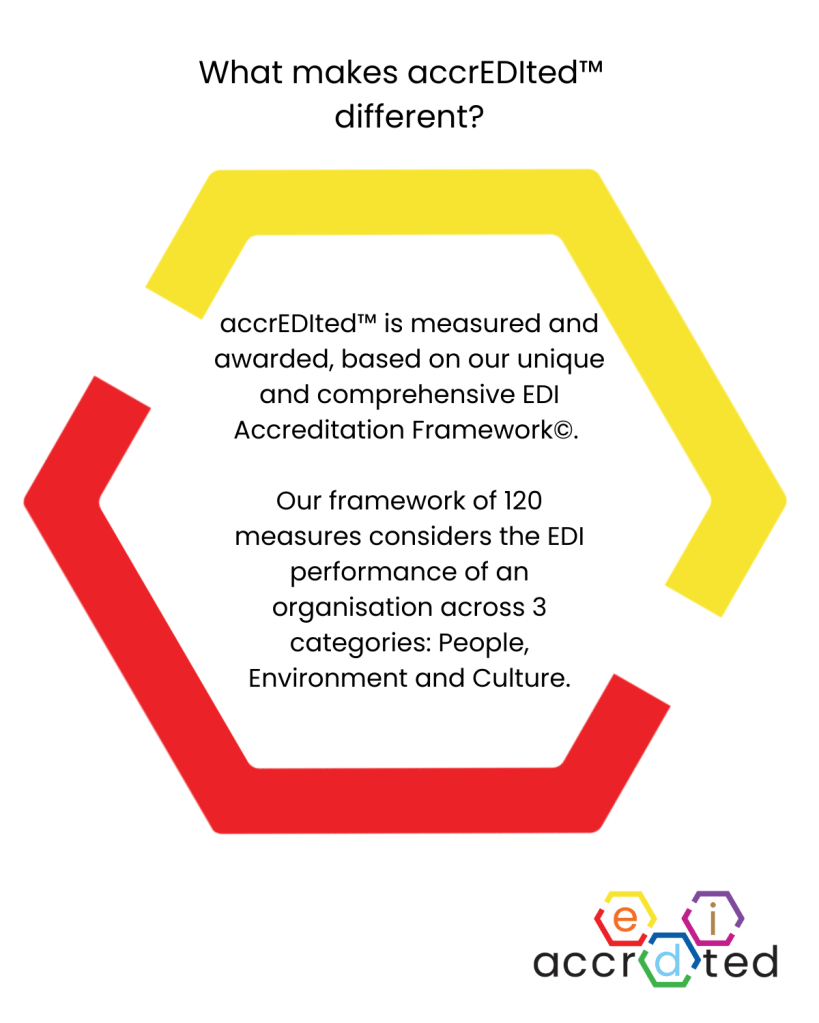
Credible EDI accreditation requires evidence for every measure. This includes analysing workforce data and capturing employee experience through cultural assessment. These elements are embedded within our framework, which is designed to deliver comprehensive, intersectional EDI measurement.
When accreditation fails to measure real outcomes, it risks becoming performative. Strong EDI standards must reflect best practice, drive improvement, and support continuous progress rather than one-off certification. Our accreditation ensures assessment goes beyond compliance and drives real impact.
Effective EDI accreditation frameworks encourage organisations to embed inclusion into strategy, monitor progress over time, and remain accountable. Our framework supports this by setting clear expectations and measuring progress year on year.
EDI accreditation should not be about compliance alone. It should provide a trusted benchmark, meaningful insight, and a clear path to lasting change.
Find out how our framework can be the start of your credible, evidence-based EDI accreditation journey.
Huge congratulations to CMF Ltd on starting their journey to become accrEDIted™.
We look forward to working with Despina Karagianni, Tim Wilford MCIOB and the team at CMF in the coming weeks to celebrate your EDI commitment and help guide your ongoing improvement.
Why Independent Oversight Matters in EDI Accreditation
Independent oversight is essential for credible EDI accreditation. It encourages honesty, builds trust, and delivers meaningful insight into an organisation’s Equality, Diversity and Inclusion (EDI) performance.
EDI accreditation should give organisations confidence that their progress has been assessed fairly and accurately. That confidence can only exist when evaluation is independent, impartial, and evidence-based.
The Limitations of Self-Assessment in EDI
Most organisations pursuing EDI accreditation are committed to best-practice and improvement. However, self-assessment, or reporting, has clear limitations.
When organisations evaluate their own EDI strategies, unconscious bias can influence outcomes. Being closely involved in the work makes it difficult to remain fully objective — a challenge commonly described as marking your own homework.
Independent EDI accreditation reduces this risk by introducing external scrutiny and informed challenge.
“You Don’t Know What You Don’t Know” in EDI Work
Everything we do is shaped by perspective, including EDI strategies and initiatives. Without lived experience or specialist knowledge about all nine protected characteristics — organisations may unintentionally overlook key issues.
Even well-designed EDI strategies can exclude people if gaps are not identified. Independent oversight brings external expertise, ensuring assessments reflect comprehensive workplace experiences rather than a partial view.
The Complexity of Intersectional EDI
EDI best practice is intersectional and complex. Focus or effort in one or two key areas area does not guarantee inclusion across all protected characteristics and in some instances can be counterproductive.
Independent EDI assessment allows organisations to move beyond surface-level compliance and truly understand how policies, culture and employee experience interact across all different identities.
This level of insight is critical for long-term, sustainable EDI improvement.
Conflicts of Interest in EDI Accreditation
Some EDI accreditations are offered by organisations that also sell consulting or training services. This creates a potential conflict of interest.
If an accrediting body benefits financially from identifying gaps or selling solutions, impartiality may be compromised. Credible EDI accreditation must be free from commercial influence.
True independence means the accrediting organisation has nothing to gain and nothing to lose from the result.
What Credible Independent EDI Accreditation Looks Like
Effective independent EDI accreditation should:
Be based on robust data and employee experience
Include specialist and lived-experience insight
Be reviewed by an independent panel
Avoid consulting, training, or upselling incentives
Only then can accreditation outcomes be trusted by employees, stakeholders, and the wider public.
Why Choose accrEDIted™ for Independent EDI Accreditation
Too often, organisations focus on earning a visible mark of approval — particularly in Equality, Diversity & Inclusion — without sufficient evidence of impact. At its core, accreditation exists to bring clarity, credibility, and consistency to how quality is defined and demonstrated.
Beyond the Label: Defining Clear Standards
Recent scrutiny of major brands over misleading sustainability and ethics claims has highlighted a simple truth: when standards are unclear or poorly evidenced, trust erodes.
Similar questions raised about initiatives such as the Disability Confident scheme reinforce the need for stronger, more transparent approaches.
Accreditation marks can be powerful when they are meaningful. Frameworks such as ISO, Red Tractor, Fairtrade, and B Corp are trusted because they demand rigour, independent scrutiny, and sustained commitment.
That is why accreditation must recognise genuine action and measurable impact, not symbolic gestures.
Accreditation brings clarity by establishing clear, evidence-based standards. These define what good practice looks like in reality and align expectations across stakeholders. Without this clarity, organisations risk inconsistency and performative compliance; with it, improvement becomes focused and measurable.
Building Credibility Through Verification
Credibility is not claimed — it is earned.
Accreditation validates quality through independent, recognised benchmarks. In short: credibility comes from verification, not intention.
This is particularly critical for Equality, Diversity & Inclusion, where aspiration alone is no longer enough. accrEDIted™ was created to meet this need, providing an evidence-led way for organisations to demonstrate real progress on EDI in the workplace.
By answering a fundamental question — can this organisation be trusted to deliver what it commits to? — accreditation builds confidence among employees, partners, and wider stakeholders.
Consistency That Can Be Trusted
Maintaining quality over time is one of the greatest challenges organisations face.
Accreditation supports consistency by embedding standards into systems and processes, not one-off assessments. Put simply: the goalposts don’t move.
Through structured reviews, clear performance indicators, and ongoing evaluation, accreditation helps ensure outcomes remain reliable year after year.
How Our Accreditation Framework Helps
Our accreditation framework is designed to bring clarity, credibility, and consistency to Equality, Diversity & Inclusion in a rigorous and measurable way.
Credibility is reinforced through our collaboration with leading human rights charity partners, including:
Consortium LGBT
Disability Rights UK
Global Butterflies
Radical Recruit
The Runnymede Trust
The Faith & Belief Forum
Consistency is built into every stage of the process. Every application is scored against the same fixed framework and reviewed by our Independent Accreditation Panel to ensure fairness and impartiality. Annual reaccreditation enables organisations to track progress and demonstrate sustained commitment over time.
Together, this approach enables organisations to evidence their position clearly, demonstrate credibility through independent assessment, and embed consistent EDI practice.
A Clear Commitment to Quality
Quality doesn’t happen by chance.
It must be defined. It must be measured. And it must be sustained.
If EDI matters, the standards behind it matter too.
If you want to bring Clarity, Credibility and Consistency to your EDI approach, start your EDI Journey with us today.
At a time where EDI accreditations are being called into question, what makes accrEDIted™ different?
Schemes like Disability Confident have been called into question recently, as organisations signed up, to the government’s Disability Confident scheme, have been found not to employ greater numbers of disabled people, or even to offer better accessibility to opportunities. So what is the point of displaying the badge?
At The EDI Mark C.I.C. we were determined accrEDIted™ would be different. It would be meaningful, it would be thorough and most importantly, it would create positive change for EVERYONE in the world of work.
Guaranteeing every voice is heard and every perspective considered throughout the accreditation process.
We measure and analyse who is represented in the organisation and where, if pay and rewards are equitable, if employee policies, operations and procedures are fair and fit for purpose, removing barriers and providing equal opportunities for everyone to thrive.
Uniquely, and most importantly, every measure is also evidenced by understanding how your people actually FEEL!
Good policies do not automatically reflect the authentic culture of an organisation. Our accreditation is only awarded where data and policies align with the lived reality of the people working there.
Our Accreditation cannot simply be bought – it is only awarded to organisations who genuinely meet our exacting standards.
So if you are an organisation genuinely committed to improving Equality, Diversity and Inclusion for all your people, accrEDIted™ provides a meaningful measure you can trust. Why not start your journey today?
To find out more about becoming accrEDIted™, visit our website today.
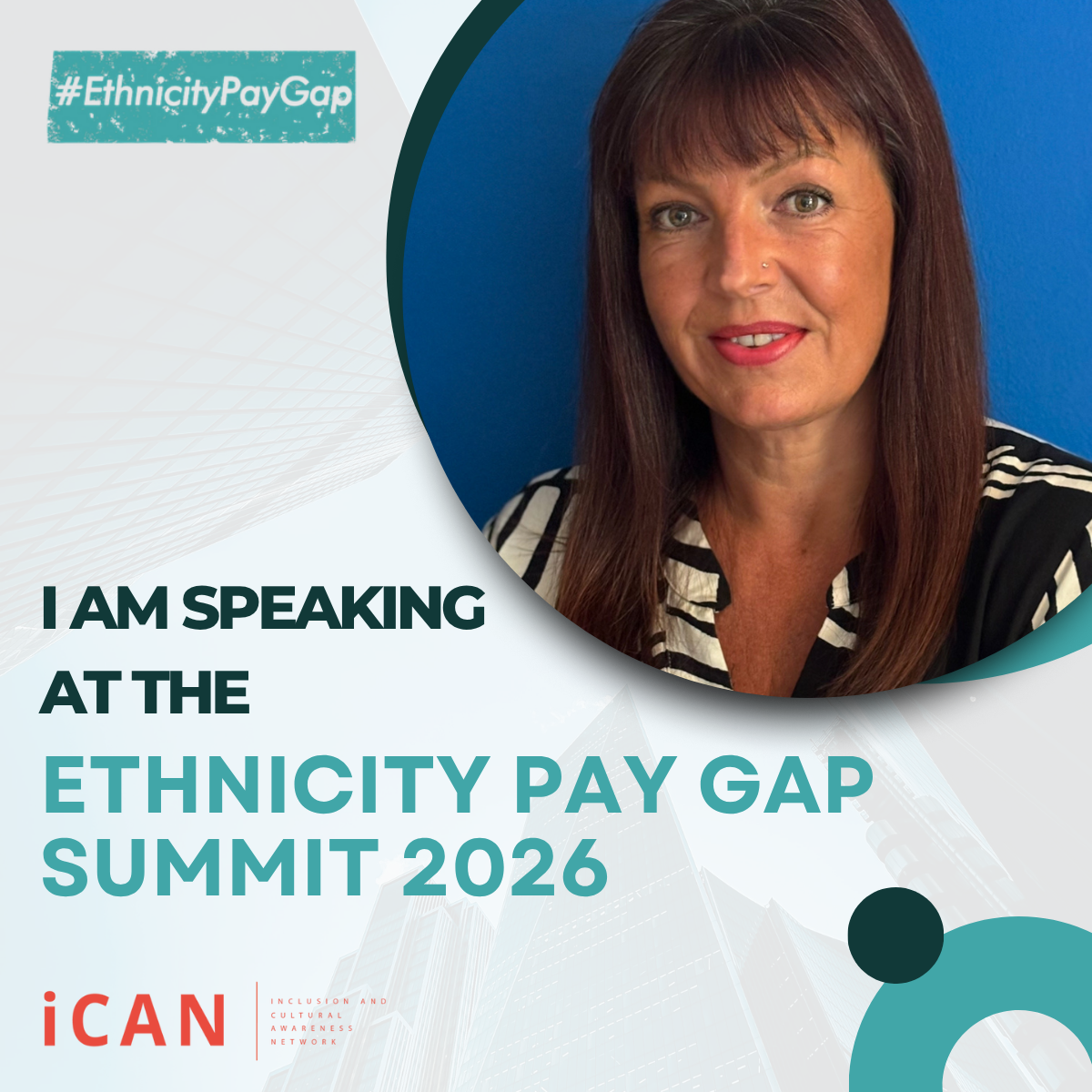
accrEDIted™ are thrilled to be speaking at the Ethnicity Pay Gap Summit 2026.
The #EthnicityPayGap Campaign are members of the accrEDIted™ Community.
Founded by the brilliant Dianne Greyson the #EthnicityPayGap Campaign is not just supporting, but driving change, when it comes to eliminating the Ethnicity Pay Gap.
In the UK in 2018, the Ethnicity Pay Gap was estimated to be a staggering £3.2 billion (and is likely to have increased since then).
At accrEDIted™, we know equality in the workplace means equality of pay. So as part of the accreditation process, we analyse pay equity. For us, it’s always been a given, that a company who genuinely cares about EDI will make sure they are paying all their employees fairly and equally and is working to correct historic inequalities.
Whilst Gender Pay Gap reporting is mandatory in the UK, Ethnicity and Disability pay gaps can still be hidden and overlooked, with only 44% voluntarily reporting their Ethnicity Pay Gap in the past. So we love the work the #EthnicityPayGap Campaign is doing to drive change by making reporting and corrective action mandatory, and are delighted to be speaking at the 2026 Ethnicity Pay Gap Summit.